Tag: battery

  • Solar Power: First Month Online, Panel Angles and Patterns

    Generation

    The numbers are in after our first month of solar photovoltaic energy production with permanent internet connection on both buildings and without system trips.
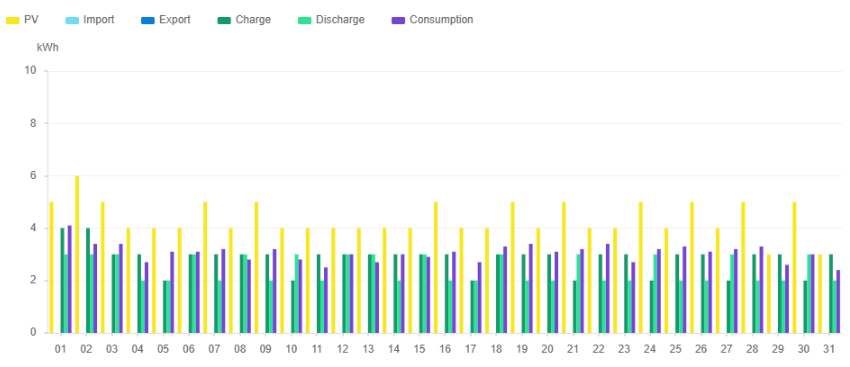
    The gatehouse building generated 135kWh and used 95kWh powering the electric fence and outside lights, with occasional kettle use.

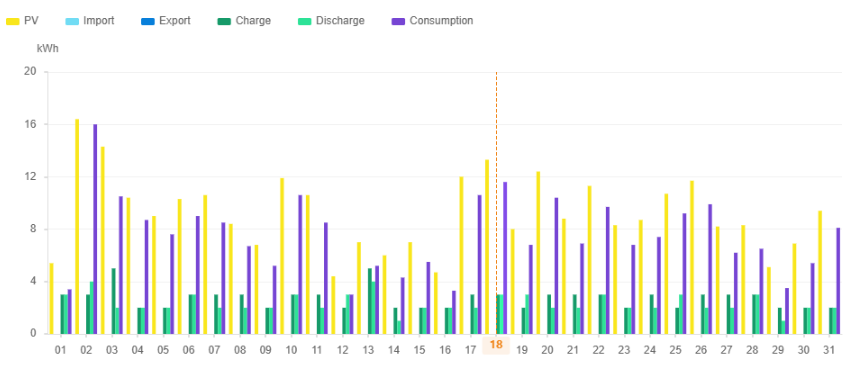
    The homestead generated almost twice that at 286kWh with 235kWh used running the borehole pump, irrigation pump, electric water heater, fridge, outside lights and internet router.

    The first thing that I take from this is that we are “losing” 30-40kWh per month in overheads to the Solis S6 5kW inverters and Freedom Won eTower 5kWh batteries.

    This seems to tally with Solis’s reported ~40W inverter self-use and Freedom Won’s claimed 95% battery efficiency.

    Angles and Patterns

    If you read the other post you will know we have two installations on separate buildings. One building was built from the outset with solar panels in mind with supposedly optimal roof pitch, the other one evolved from a simple set of rooms to a set of rooms with covered veranda and kitchen, with only a minimal roof pitch.
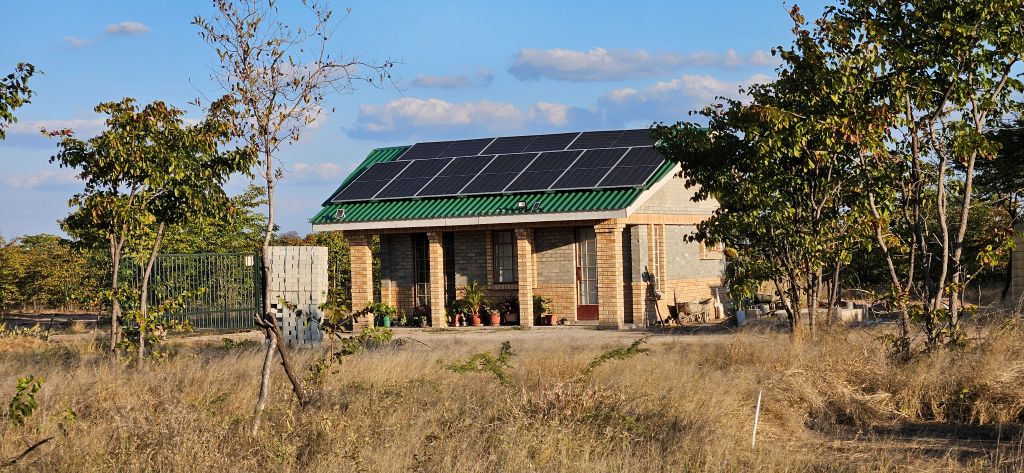
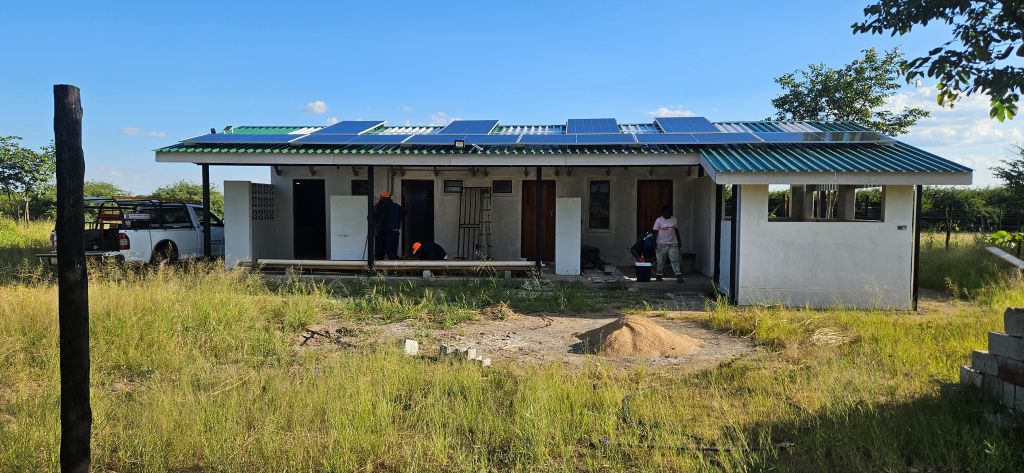
    The difference in solar harvesting is noticeable in the morning as the optimal pitch roof has an almost continual ramp-up in the power it generates as the sun rises. Contrast that with the shallow pitch roof that has an almost flat line for the first hour or so, then a sudden step, followed by the steady ramp-up. Although the ramp-up is also slightly shallower.

    As we are a couple of degrees north of the Tropic of Capricorn I’m looking forward to observing the difference when the sun is to the south of us in December.
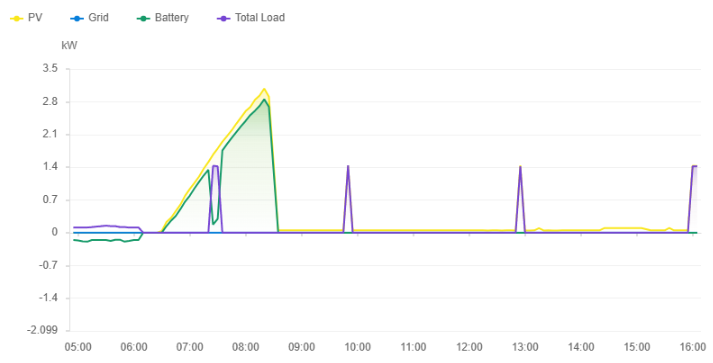
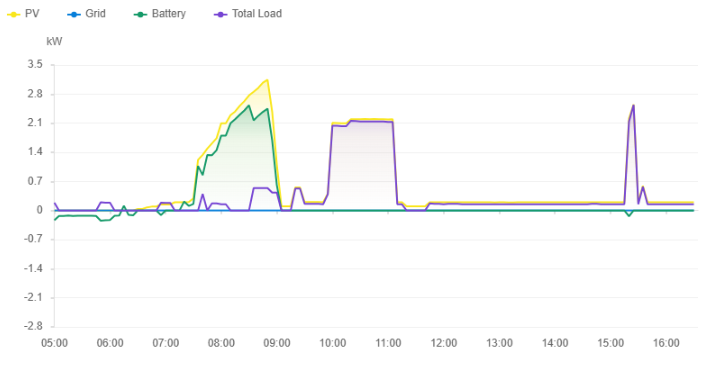
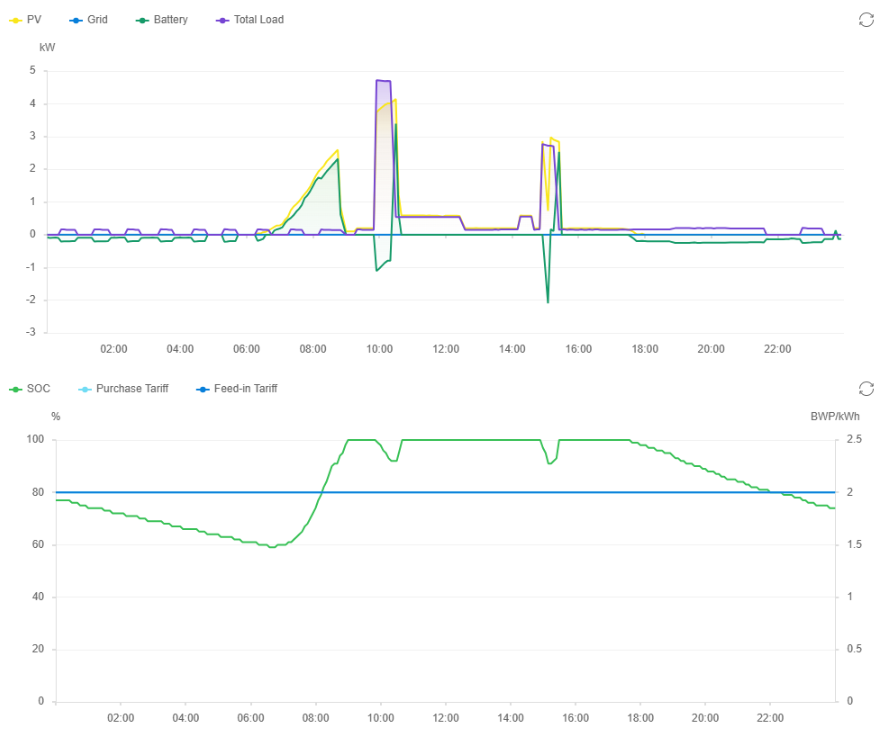
    As for usage patterns: the batteries typically draw down to 50-55% state of charge overnight and are recharged within a couple of hours of sunrise.

    In the left hand chart is can be seen that when our farmworkers boil water for their morning tea it pulls almost all the power available, slowing down battery charging. For the rest of the day there is plenty of spare capacity.

    On the right hand chart we can see the fridge cycling on and off using >100W of power, and a continuous run in the afternoon when it has been loaded with water for chilling or freezing. The larger step while the battery is charging is from the irrigation pump, and a big jump at 10:00 when the timer switches on the 2kW water heater which runs for 30-35 minutes or so, followed by the borehole pump being switched on and drawing just over 2kW while running.

    Below is an example of a day when the borehole and irrigation pumps were turned on before the water was up to temperature and the sun had reached its zenith, so drawing about 1kW from the battery to supplement the 4kW from panels. Later in the afternoon the water heater and irrigation pump runs again – probably while someone was showering – with the sun low in the sky and barely able to provide the required power. It also looks like there was a brief patch of cloud or other obstruction causing ~2kW to be drawn from the battery for a moment.
  • Solar Power: Freedom Won eTower BMS Challenges

    We’re working on a little project, the details of which will be revealed in due course.

    A few months ago we installed a couple of solar systems: each one consisting of a 5kW Solis S6 inverter, Freedom Won eTower 5kWh battery and ten Canadian Solar 585W bifacial Evo 2 panels.

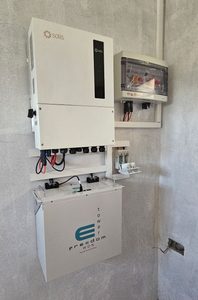
    Solar power installation including a Solis S6 inverter, Freedom Won eTower battery, a photovoltaic combiner box and DC fuse holder.

    They started off working steadily, but not hard – exterior lighting and light domestic use. One installation works a little harded as it is connected to a borehole with a 2.5kW operating load for an hour or so most days.

    The more lightly loaded installation started having intermittent battery trips, usually in the afternoon. Then a couple of weeks later the unit running the borehole started having the same problem, but on a daily basis and eventually multiple times per day but at fairly consistent times: early morning, early afternoon and early evening.

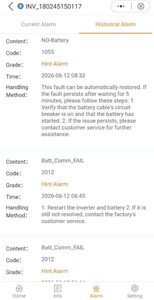
    To explain “battery trip” the inverter would remain online, at least in daytime while the panels were providing power, but the battery would go offline and require a poke in the reset hole to bring it back online. The inverter would initially send a “Batt_Comm_FAIL” error and after an hour or two followup with a “NO-Battery” notification.

    We tried a few simple tests: checking the CANBUS cable between battery and inverter for pinouts, taking the cable out of the trunking to eliminate electrical interference, and updating inverter firmware. The Freedom Won eTower battery is not capable of being updated over the internet or by the owner.

    The batteries were bought online from Voltex around September 2025, and the serial numbers indicate they were manufactured in 2023, so had been sitting in a warehouse for a couple of years already. A cursory search suggests Freedom Won started selling eTowers in 2021.

    Whilst troubleshooting I found some discrepancies in documentation and hardware depending which search results you find. Different inverter manufacturers use different pin combinations on the RJ45 CANBUS sockets, and Freedom Won include two cable types with the battery to suit the most common. Some online documentation has contradictory pin or cable combinations: approach with caution.

    To cut a long story short: the standard ethernet cable included with the inverter works with the eTower battery.

    Accepting that this was not something we could solve ourselves I opened support tickets with Freedom Won, and (on request) they were kind enough to provide ex-works a USB to RJ11/RS232 cable that was collected by my friendly cross-border transporter.

    A brief intermission while waiting for a break from the day job and we made an appointment with a Freedom Won technician to update battery firmware and check the settings to restore normal operation. To do this they need you to install Teamviewer and work remotely: so you need a decent internet connection.

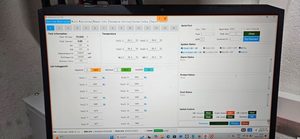
    They will download PBMS Tools – it seems Freedom Won eTowers use Pace Battery Management Systems – and connect to the battery. The default password is available online using intuitive search terms.

    Disclaimer: Poking around in the BMS on your own may damage or brick your battery and or system.

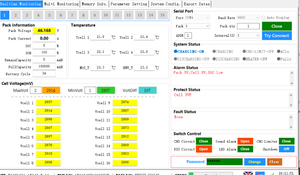
    Watching the process I could see them download and install the latest battery/BMS firmware, and check the cell voltages. It looked like some cells had significantly different voltages to others, indicating a balancing issue.

    That was the easy one… it has been running constantly for about a month now without trips or other issues.

    The other system had gone so deep into self-protection* that it would not stay on for any extended period: we managed to keep it up long enough for technician to install the firmware, instruct a round of battery balancing and disconnect.

    * the BMS kept shutting down the battery, so the inverter was not sending electricity to charge it, and the person staying in the building kept resetting the battery to try and get power…

    The technician said everything was good, but everything was not good: the inverter was still not detecting the battery and so was not sending power to it to charge: despite the BMS saying the charging circuit was closed.

    At this point the technician stopped responding on WhatsApp so it was over to the civil engineer to find a solution.

    It didn’t take too many braincells to workout that the alarms relate to low pack voltage (the whole battery), low cell voltage (the individual cell packs), and low state of charge. Bonus points for the indication that the battery was in a protection state due to low cell voltages.

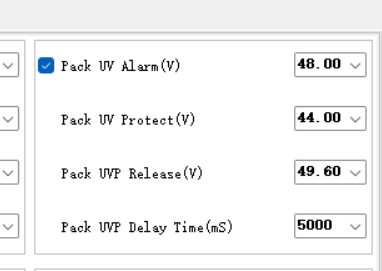
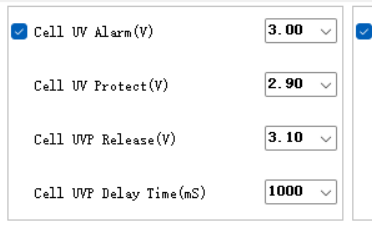
    A rummage through the settings and I found the menus with voltage settings:

    These are intended to prevent over-discharge of the battery and cells, so when the battery goes into under-voltage protection (UVP) mode the BMS disconnects the battery terminals from the cells, and so can neither give or receive power.

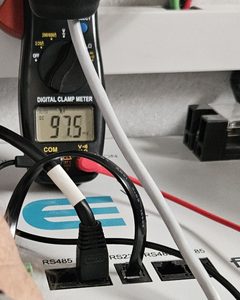
    Voltmeter measuring a few millivolts across the terminals of a Freedom Won eTower battery in a low voltage protection state, i.e. shutdown.

    Whilst the pack voltage was above the Pack UVP most of the individual cells were below the Cell UVP.

    After taking screenshots of the default settings I reduced the Cell UVP to 2.8V, and was rewarded with some clicks and indications of life from battery and inverter.

    I left the system charging and returned later to reset to defaults.

    After a couple of months I am pleased to report that the battery trips are a thing of the past, and I have since become a solar PV nerd obsessed with charging, discharging, and weather.

    It’s not clear what was causing the original trips as they were occurring mostly in daytime or early evening when voltages should have been sufficient – unless some cells were so unbalanced they were hitting under- or over-voltage limits and triggering the protection mode.