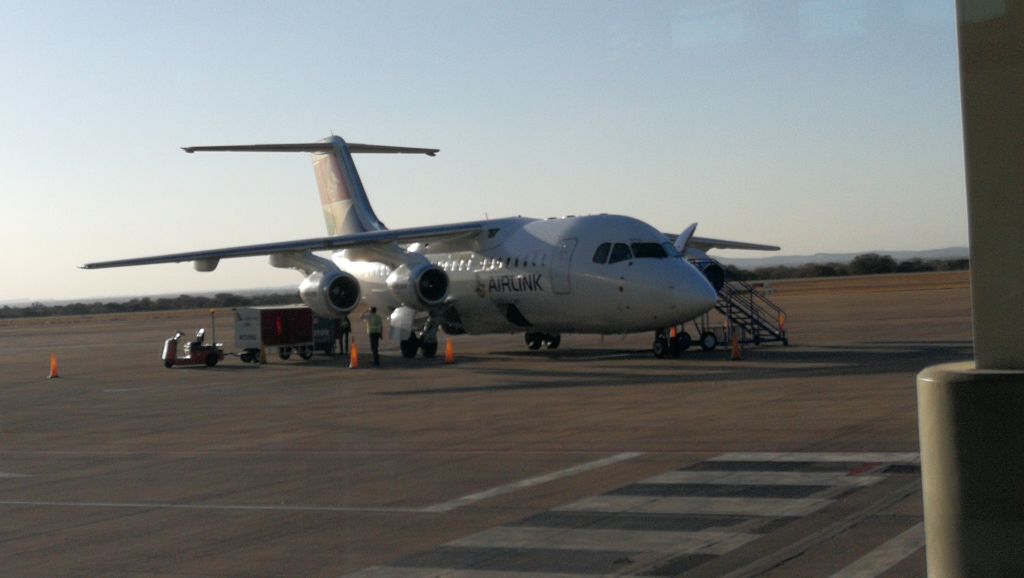
Something from OneDrive Memories today 3 October: an Airlink Avro RJ85 on the apron at Sir Seretse Khama International Airport, Gaborone, Botswana back in 2019.
As a regular flyer on Airlink for the last few years flights become a bit of a blur, so I don’t remember if I flew on this aircraft or if it happened to be on the apron while I was waiting for another flight.
Air Botswana also operated two Avro RJ85s, retiring theirs in 2015. One of them is visible on Google Earth on the periphery of SSKIA.
Four engines on a relatively small airframe gave it good short field performance, and a high-level of redundancy when operating in remote areas, and “hot and high” airports, such as those in much of Botswana (mostly around 1,000m above mean sea-level) and South Africa.
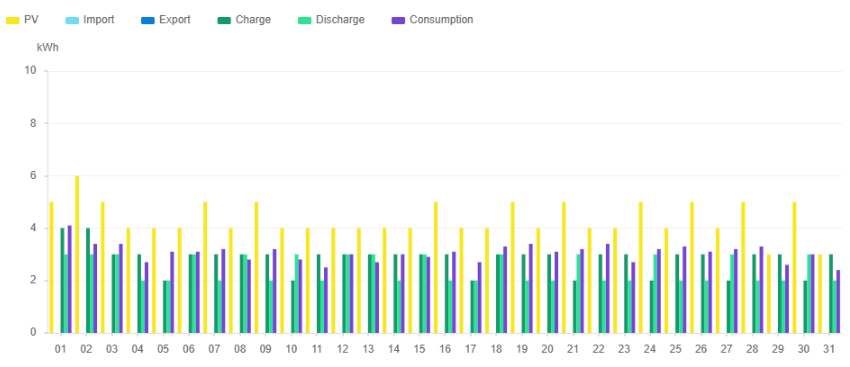
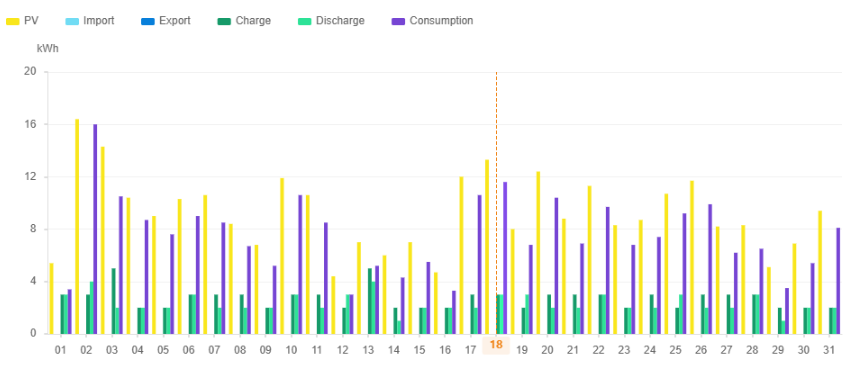
The numbers are in after our first month of solar photovoltaic energy production with permanent internet connection on both buildings and without system trips.
The gatehouse building generated 135kWh and used 95kWh powering the electric fence and outside lights, with occasional kettle use.
The homestead generated almost twice that at 286kWh with 235kWh used running the borehole pump, irrigation pump, electric water heater, fridge, outside lights and internet router.
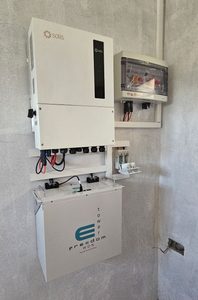
The first thing that I take from this is that we are “losing” 30-40kWh per month in overheads to the Solis S6 5kW inverters and Freedom Won eTower 5kWh batteries.
This seems to tally with Solis’s reported ~40W inverter self-use and Freedom Won’s claimed 95% battery efficiency.
Angles and Patterns
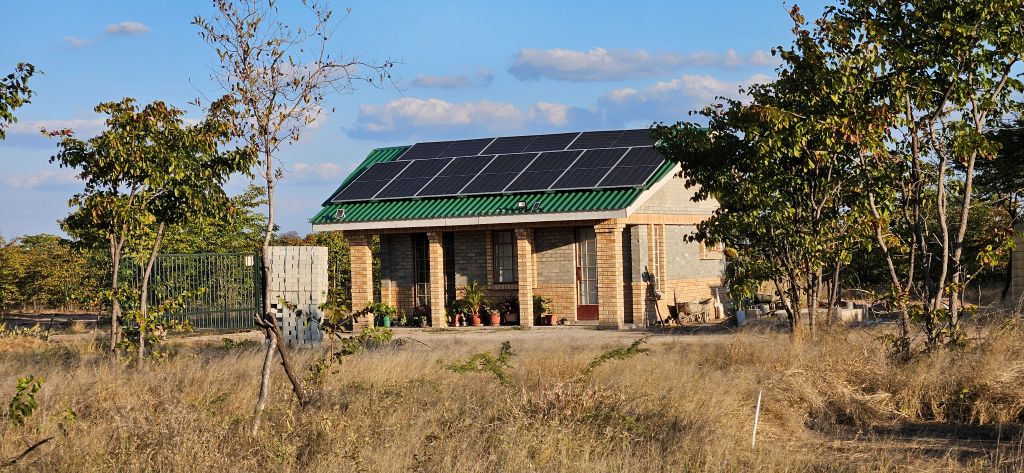
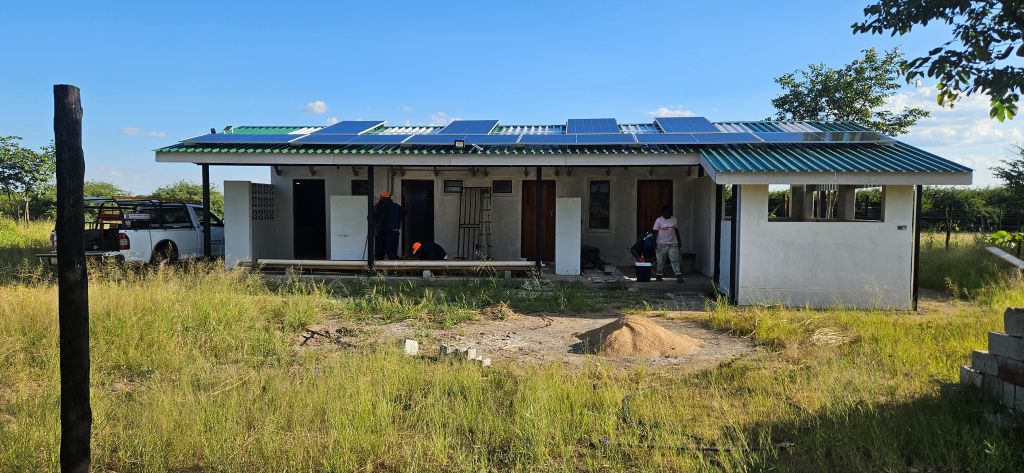
If you read the other post you will know we have two installations on separate buildings. One building was built from the outset with solar panels in mind with supposedly optimal roof pitch, the other one evolved from a simple set of rooms to a set of rooms with covered veranda and kitchen, with only a minimal roof pitch.
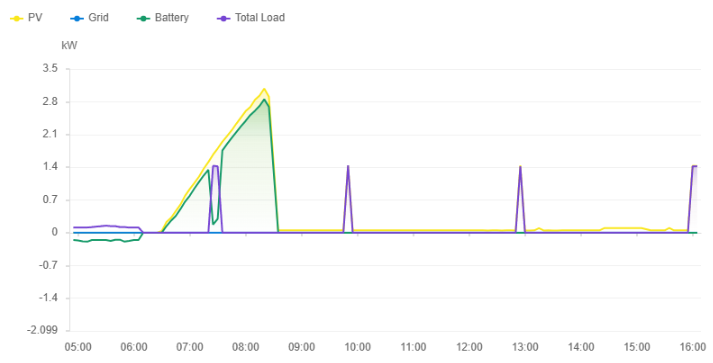
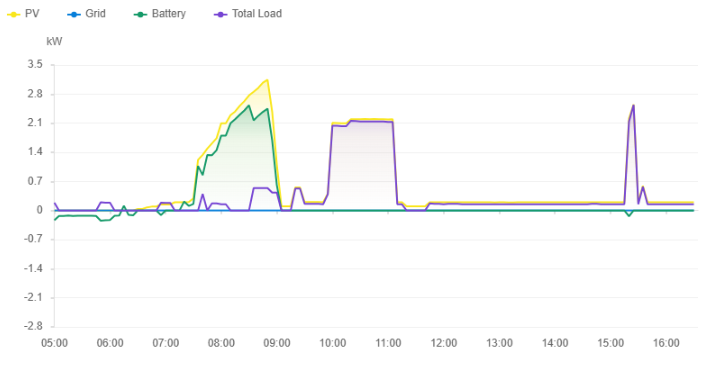
The difference in solar harvesting is noticeable in the morning as the optimal pitch roof has an almost continual ramp-up in the power it generates as the sun rises. Contrast that with the shallow pitch roof that has an almost flat line for the first hour or so, then a sudden step, followed by the steady ramp-up. Although the ramp-up is also slightly shallower.
As we are a couple of degrees north of the Tropic of Capricorn I’m looking forward to observing the difference when the sun is to the south of us in December.
As for usage patterns: the batteries typically draw down to 50-55% state of charge overnight and are recharged within a couple of hours of sunrise.
In the left hand chart is can be seen that when our farmworkers boil water for their morning tea it pulls almost all the power available, slowing down battery charging. For the rest of the day there is plenty of spare capacity.
On the right hand chart we can see the fridge cycling on and off using >100W of power, and a continuous run in the afternoon when it has been loaded with water for chilling or freezing. The larger step while the battery is charging is from the irrigation pump, and a big jump at 10:00 when the timer switches on the 2kW water heater which runs for 30-35 minutes or so, followed by the borehole pump being switched on and drawing just over 2kW while running.
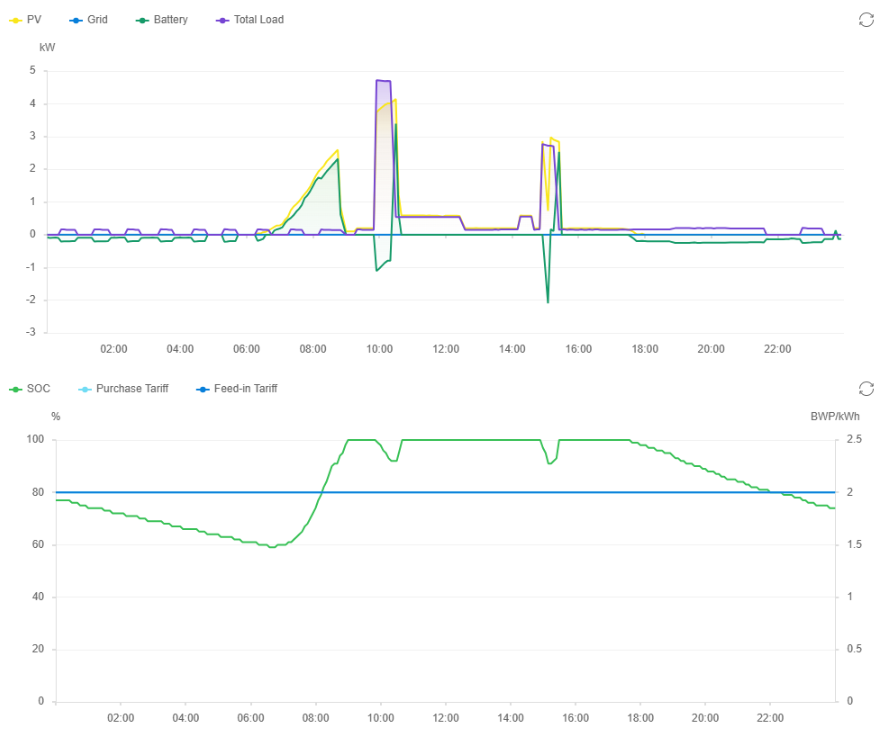
Below is an example of a day when the borehole and irrigation pumps were turned on before the water was up to temperature and the sun had reached its zenith, so drawing about 1kW from the battery to supplement the 4kW from panels. Later in the afternoon the water heater and irrigation pump runs again – probably while someone was showering – with the sun low in the sky and barely able to provide the required power. It also looks like there was a brief patch of cloud or other obstruction causing ~2kW to be drawn from the battery for a moment.
They started off working steadily, but not hard – exterior lighting and light domestic use. One installation works a little harded as it is connected to a borehole with a 2.5kW operating load for an hour or so most days.
The more lightly loaded installation started having intermittent battery trips, usually in the afternoon. Then a couple of weeks later the unit running the borehole started having the same problem, but on a daily basis and eventually multiple times per day but at fairly consistent times: early morning, early afternoon and early evening.
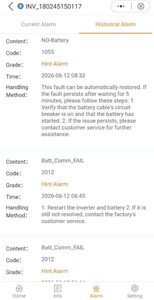
To explain “battery trip” the inverter would remain online, at least in daytime while the panels were providing power, but the battery would go offline and require a poke in the reset hole to bring it back online. The inverter would initially send a “Batt_Comm_FAIL” error and after an hour or two followup with a “NO-Battery” notification.
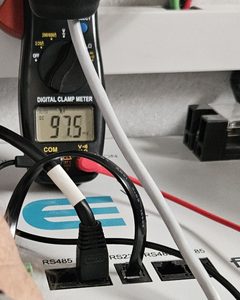
We tried a few simple tests: checking the CANBUS cable between battery and inverter for pinouts, taking the cable out of the trunking to eliminate electrical interference, and updating inverter firmware. The Freedom Won eTower battery is not capable of being updated over the internet or by the owner.
The batteries were bought online from Voltex around September 2025, and the serial numbers indicate they were manufactured in 2023, so had been sitting in a warehouse for a couple of years already. A cursory search suggests Freedom Won started selling eTowers in 2021.
Whilst troubleshooting I found some discrepancies in documentation and hardware depending which search results you find. Different inverter manufacturers use different pin combinations on the RJ45 CANBUS sockets, and Freedom Won include two cable types with the battery to suit the most common. Some online documentation has contradictory pin or cable combinations: approach with caution.
To cut a long story short: the standard ethernet cable included with the inverter works with the eTower battery.
Accepting that this was not something we could solve ourselves I opened support tickets with Freedom Won, and (on request) they were kind enough to provide ex-works a USB to RJ11/RS232 cable that was collected by my friendly cross-border transporter.
A brief intermission while waiting for a break from the day job and we made an appointment with a Freedom Won technician to update battery firmware and check the settings to restore normal operation. To do this they need you to install Teamviewer and work remotely: so you need a decent internet connection.
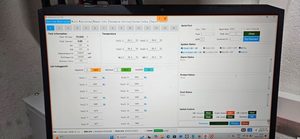
They will download PBMS Tools – it seems Freedom Won eTowers use Pace Battery Management Systems – and connect to the battery. The default password is available online using intuitive search terms.
Disclaimer: Poking around in the BMS on your own may damage or brick your battery and or system.
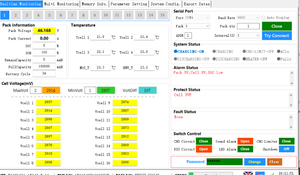
Watching the process I could see them download and install the latest battery/BMS firmware, and check the cell voltages. It looked like some cells had significantly different voltages to others, indicating a balancing issue.
That was the easy one… it has been running constantly for about a month now without trips or other issues.
The other system had gone so deep into self-protection* that it would not stay on for any extended period: we managed to keep it up long enough for technician to install the firmware, instruct a round of battery balancing and disconnect.
* the BMS kept shutting down the battery, so the inverter was not sending electricity to charge it, and the person staying in the building kept resetting the battery to try and get power…
The technician said everything was good, but everything was not good: the inverter was still not detecting the battery and so was not sending power to it to charge: despite the BMS saying the charging circuit was closed.
At this point the technician stopped responding on WhatsApp so it was over to the civil engineer to find a solution.
It didn’t take too many braincells to workout that the alarms relate to low pack voltage (the whole battery), low cell voltage (the individual cell packs), and low state of charge. Bonus points for the indication that the battery was in a protection state due to low cell voltages.
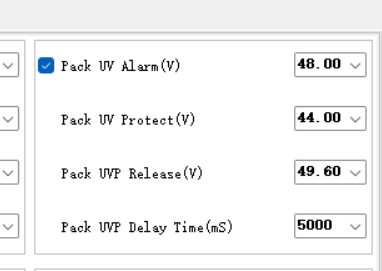
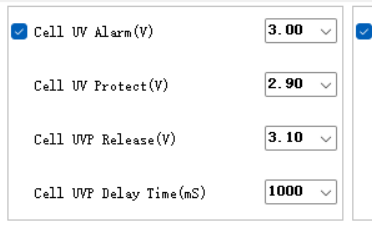
A rummage through the settings and I found the menus with voltage settings:
These are intended to prevent over-discharge of the battery and cells, so when the battery goes into under-voltage protection (UVP) mode the BMS disconnects the battery terminals from the cells, and so can neither give or receive power.
Whilst the pack voltage was above the Pack UVP most of the individual cells were below the Cell UVP.
After taking screenshots of the default settings I reduced the Cell UVP to 2.8V, and was rewarded with some clicks and indications of life from battery and inverter.
I left the system charging and returned later to reset to defaults.
After a couple of months I am pleased to report that the battery trips are a thing of the past, and I have since become a solar PV nerd obsessed with charging, discharging, and weather.
It’s not clear what was causing the original trips as they were occurring mostly in daytime or early evening when voltages should have been sufficient – unless some cells were so unbalanced they were hitting under- or over-voltage limits and triggering the protection mode.
Unexpected gifts arrived last week. After six years of working with Chinese EPC contractors we have spent most of this year bereft of Chinese culture and socialisation. This didn’t stop our most recent ex-contractor from making a special visit to drop off seasonal gifts that were rapidly distributed through the offices and corridors.
Mid-Autumn Festival gift of Dao Xiang Cun mooncakes.
Based on the Chinese lunisolar calendar Mid-Autumn Festival, aka Moon Festival, is celebrated at the full moon between mid-September and mid-October, equivalent to Western harvest festival celebrating a (hopefully) successful harvest.
Last year we made four trips to Beijing for business, but on review the August trip, closest in season to now, was not particularly cultural as we were on a tight schedule. We did manage to find an Irish Pub to watch South Africa (my colleagues being South African) play Australia in The Rugby Championship (equivalent of the Six Nations, but south of the Equator and only four teams).
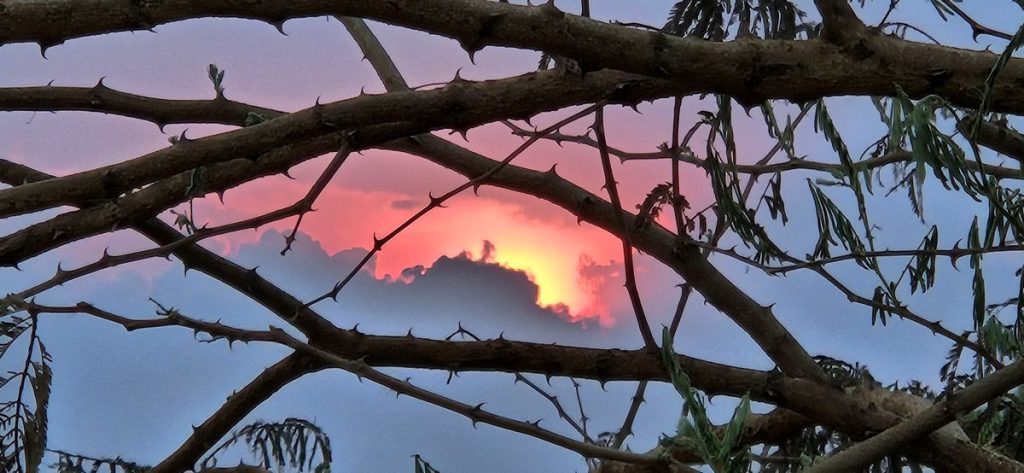
Meanwhile, in the DRC we have had the first showers (well, a round of drops and one short downpour), trees are budding new leaves, or simply doing a quick colour change, and frogs are invading our personal spaces (when they are not showing suicidal tendencies under our boots).
Seeking a change from my go-to of Soundcloud streaming tonight I cued up a trilogy of Dreadzone’s Biological Radio, Lionrock’s Instinct for Detection and The Drum Club’s Everything is Now. Three favourite soundscapes from my youth, best listened to in the context of the albums from whence they came.
Four out of the last seven years actively administering EPC contracts with Chinese contractors, plus four trips to China last year for meetings with one of those contractors, all the while assisted by colleagues from our China office.
It’s been a heck of a ride.
🌚🎉🎇🐍 etc.
I was lucky enough to see Underworld live at the 1996 Reading Festival during the Born Slippy era – a tent full of madness (some of the YouTube tracks show the main stage).
What caught my eye in the summary sidebar was the “Platforms: 2. Tracks: 11.” My nerdly knowledge of railways suggests these are exchange sidings, which in turn indicates industry – confirmed by the body text referring to coal washeries and nearby Bokaro Steel City.
Definitely worth exploring.
The junction itself is not too remarkable – a small settlement probably serving the railway workers of the South Eastern Railway zone. The SER headquarters building in Kolkata is a typical wild monument to colonial bureaucracy: red brick and turrets in abundance. Probably worth throwing in a reference to the three-part BBC documentary that I have tucked away on my media-server under the title “The Great Indian Railway” – unfortunately there are a lot of links to YouTube under that title, but so far I have not managed to identify one with the corresponding content.
Where are the coal washeries? Well, you have to head north-west to the Stygian pits and satanic mills.
I particularly like that the (presumably disused) wash plant to the east is being consumed by the forest, and even the new five million ton per annum plant to the west looks like it is fighting hard to stay above the shrubbery.
Last satellite image for the day takes us to the steel smelter and rolling mills of the Bokaro Steel Plant. Interesting to note that it was built a couple of decades after independence, using Soviet technology during a period when the Soviet Union was providing significant aid to the region.
Half a century later it is probably “Trigger’s Broom” with most of the equipment having been replaced with locally produced equipment. We hear a lot about Chinese industry, but I recognise the Larsen & Toubro name as one that has been involved in large powerline projects in Africa, with an office in Botswana last time I checked.
We are also working closely with a local contractor of Indian heritage on my current project in the DRC: their professionalism is impressive and I enjoy dealing with them.
This one slipped into my headphones on Sunday and saw me through another Excel session (nobody else in the office, no incoming emails, no disturbances).